
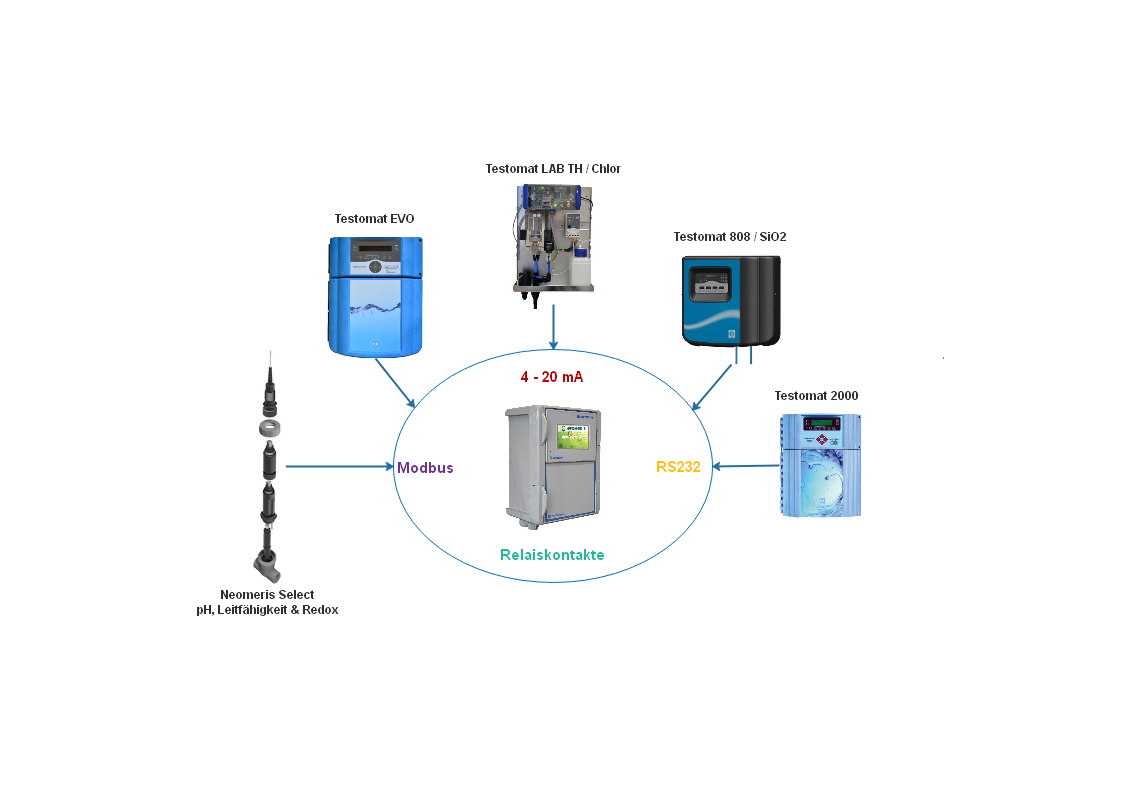
The NeoTecMaster, as a multi-parameter system open to any manufacturer, enables you to monitor your water treatment plant, regardless of your location.
The multicontroller allows customer-specific extensions, e.g. connection to the cell phone network via GSM. In this category you will find all products necessary for your specific application and configuration of your NeoTecMaster. The technical selection options can be summarized as follows:
- Available as 1 to 8 -channel system
- Modular concept for signal inputs (Modbus-RTU, 4-20mA or RS232)
- Software architecture for the integration of Heyl Testomat instruments, such as Testomat EVO, Testomat 2000, Testomat LAB and Testomat 808 / 808 SIO2
- Possibility of integrating the entire NeoTec Neomeris Select sensors
- Integration of non-proprietary measurement technology
- Ethernet interface for network integration Visualization of status messages and measured values via web interface

Maintenance kit for Neomeris Select chlorine dioxide sensorEnsure proper operation and high measurement accuracy with our chlorine dioxide sensor service kit and also extend the life of the sensor.Content:1x Replacement membrane cap1x Replacement pressure relief strap2x 30-mL bottles of electrolyte refill solution2x 10-mL syringes3x Polishing squares

Maintenance kit for Neomeris Select free chlorine sensorEnsure proper operation and high measurement accuracy with our free chlorine sensor service kit and also extend the life of the sensor.Content:1x Replacement membrane cap1x Replacement pressure relief strap2x 30-mL bottles of electrolyte refill solution2x 10-mL syringes3x Polishing squares

Technical data: Screw-in thread: 1/2 "Material housing: POM black Material electrodes: V4A 4571 Material O-ring: EPDM Cell constant: C=0.1 +/- 10%. Max. Operating pressure: 6 bar Max. Operating temperature: 60°C Temperature sensor: PT100 Solenoid valve connector: ST2+SL electrodes Colour cable green/yellow St1+St2 PT 100 Colour cable brown/white

Technical data: Screw-in thread: 1/2 "Material housing: POM black Material electrodes: V4A 4571 Material O-ring: EPDM Cell constant: C=1.0 +/- 10%. Max. Operating pressure: 6 bar Max. Operating temperature: 60°C Temperature sensor: PT100 Solenoid valve connector: ST2+SL electrodes Colour cable green/yellow St1+St2 PT 100 Colour cable brown/white

Technical data: Screw-in thread: 3/4"Material housing: POM black Material electrodes: V4A 4571 Material O-ring: EPDM Cell constant: C=0.1 +/- 10%. Max. Operating pressure: 6 bar Max. Operating temperature: 60°C Temperature sensor: PT100 Solenoid valve connector: ST2+SL electrodes Colour cable green/yellow St1+St2 PT 100 Colour cable brown/white

Technical data: Screw-in thread: 3/4"Material housing: POM black Material electrodes: V4A 4571 Material O-ring: EPDM Cell constant: C=1.0 +/- 10%. Max. Operating pressure: 6 bar Max. Operating temperature: 60°C Temperature sensor: PT100 Solenoid valve connector: ST2+SL electrodes Colour cable green/yellow St1+St2 PT 100 Colour cable brown/white

High-quality conductivity meter with a 4-20mA signal output for forwarding the measured value to a higher-level control system, for example. The measurement is temperature compensated and therefore offers you an accurate measurement result. Also here we have the possibility to offer you an individual design regarding the connection, the LEDs including the measuring range up to a private label. Due to the acrylic glass cover used, the light of the LEDs is widely scattered and the current LED status can be seen from a distance in darker rooms. Quality Made in Germany. LED configuration according your requirements (1 green LED, 1 red LED): <.... µS/cm = green >.... µS/cm to <....µS/cm = green/red flashing >.... µS/cm = red Technical data: Measuring range: 0 - 2000 μS/cm Temperature compensation: Linear 2.2 % / K, reference temperature 25°C Accuracy conductivity: +/-10% of the maximum full scale value Accuracy temperature: +-1.0 °C Limit value display: Optical via LED Analog output: 4-20 mA = 0-2000 μS/cm Power supply: 24 VDC +-10% Power consumption: < 2.5W Screw-in thread: according yor requirements Housing: POM (polyoxymethylene) Vision panel: PMMA (acrylic glass) Electrodes: stainless steel 1.457 Dimensions: Diameter 60 mm x 60 mm (top) / 100 mm (total) Gaskets electrodes: EPDM, 28 x 3 mm Gasket housing: EPDM, 50 x 2 mm Application limits: P max: 6 bar; T max: 50 °C Protection class: IP 65*

High-quality conductivity meter with a 4-20mA signal output for forwarding the measured value to a higher-level control system, for example. The measurement is temperature compensated and therefore offers you an accurate measurement result. Also here we have the possibility to offer you an individual design regarding the connection, the LEDs including the measuring range up to a private label. Due to the acrylic glass cover used, the light of the LEDs is widely scattered and the current LED status can be seen from a distance in darker rooms. Quality Made in Germany. Standard LED configuration (1 green LED, 1 red LED): <1500 µS/cm = green >1500 µS/cm to <1900µS/cm = green/red flashing >1900 µS/cm = red Technical data: Measuring range: 0 - 2000 μS/cm Temperature compensation: Linear 2.2 % / K, reference temperature 25°C Accuracy conductivity: +/-10% of the maximum full scale value Accuracy temperature: +-1.0 °C Limit value display: Optical via LED Analog output: 4-20 mA = 0-2000 μS/cm Power supply: 24 VDC +-10% Power consumption: < 2.5W Screw-in thread: 3/4" Housing: POM (polyoxymethylene) Vision panel: PMMA (acrylic glass) Electrodes: stainless steel 1.457 Dimensions: Diameter 60 mm x 60 mm (top) / 100 mm (total) Gaskets electrodes: EPDM, 28 x 3 mm Gasket housing: EPDM, 50 x 2 mm Application limits: P max: 6 bar; T max: 50 °C Protection class: IP 65*

High-quality conductivity meter with a 4-20mA signal output for forwarding the measured value to a higher-level control system, for example. The measurement is temperature compensated and therefore offers you an accurate measurement result. Also here we have the possibility to offer you an individual design regarding the connection, the LEDs including the measuring range up to a private label. Due to the acrylic glass cover used, the light of the LEDs is widely scattered and the current LED status can be seen from a distance in darker rooms. Quality Made in Germany. Standard LED configuration (1 green LED, 1 red LED): <1500 µS/cm = green >1500 µS/cm to <1900µS/cm = green/red flashing >1900 µS/cm = red Technical data: Measuring range: 0 - 2000 μS/cm Temperature compensation: Linear 2.2 % / K, reference temperature 25°C Accuracy conductivity: +/-10% of the maximum full scale value Accuracy temperature: +-1.0 °C Limit value display: Optical via LED Analog output: 4-20 mA = 0-2000 μS/cm Power supply: 24 VDC +-10% Power consumption: < 2.5W Screw-in thread: according to your requirements Housing: POM (polyoxymethylene) Vision panel: PMMA (acrylic glass) Electrodes: stainless steel 1.457 Dimensions: Diameter 60 mm x 60 mm (top) / 100 mm (total) Gaskets electrodes: EPDM, 28 x 3 mm Gasket housing: EPDM, 50 x 2 mm Application limits: P max: 6 bar; T max: 50 °C Protection class: IP 65*

High-quality conductivity meter with a 4-20mA signal output for forwarding the measured value to a higher-level control system, for example. The measurement is temperature compensated and therefore offers you an accurate measurement result. Also here we have the possibility to offer you an individual design regarding the connection, the LEDs including the measuring range up to a private label. Due to the acrylic glass cover used, the light of the LEDs is widely scattered and the current LED status can be seen from a distance in darker rooms. Quality Made in Germany. LED configuration like requested (1 green LED, 1 red LED): <... µS/cm = green >... µS/cm to <...µS/cm = green/red flashing >... µS/cm = red Technical data: Measuring range: 0 - 2000 μS/cm Temperature compensation: Linear 2.2 % / K, reference temperature 25°C Accuracy conductivity: +/-10% of the maximum full scale value Accuracy temperature: +-1.0 °C Limit value display: Optical via LED Analog output: 4-20 mA = 0-2000 μS/cm Power supply: 24 VDC +-10% Power consumption: < 2.5W Screw-in thread: 3/4" Housing: POM (polyoxymethylene) Vision panel: PMMA (acrylic glass) Electrodes: stainless steel 1.457 Dimensions: Diameter 60 mm x 60 mm (top) / 100 mm (total) Gaskets electrodes: EPDM, 28 x 3 mm Gasket housing: EPDM, 50 x 2 mm Application limits: P max: 6 bar; T max: 50 °C Protection class: IP 65*

High-quality conductivity meter for conductivity monitoring Our innovative conductivity meter has been specially developed for monitoring conductivity in ultrapure water (demineralised water) and has a 4-20 mA signal output that enables easy integration into higher-level control systems.The measurements are temperature-compensated, which ensures greater accuracy. With a measuring range of 0 to 2 µS/cm, our device is particularly suitable for monitoring low conductivities, such as those typically found in mixed-bed ion exchanger cartridges. The limit value is displayed by means of 2 LEDs (green/red) on the top of the device. An acrylic glass cover ensures that the current status is immediately visible. The device has a ¾ screw thread, which can be customised for easy and safe installation. There is also the option of customisation in terms of the LEDs, including the measuring range and a private label. Our high-quality conductivity meter offers a reliable solution for conductivity monitoring in medical areas to fulfil the guidelines and recommendations of the DGSV. Our measuring device is also particularly suitable for mixed bed cartridge monitoring in the clinical environment. Standard LED configuration (1 green LED, 1 red LED): <0.5 µS/cm = green >0.5 µS/cm to <1.0 µS/cm = green/red flashing >1 µS/cm = red

High-quality conductivity meter with a 4-20mA signal output for forwarding the measured value to a higher-level control system, for example. The measurement is temperature compensated and therefore offers you an accurate measurement result. Also here we have the possibility to offer you an individual design regarding the connection, the LEDs including the measuring range up to a private label. Due to the acrylic glass cover used, the light of the LEDs is widely scattered and the current LED status can be seen from a distance in darker rooms. Quality Made in Germany. LED configuration according your requirements (1 green LED, 1 red LED): <.. µS/cm = green >..µS/cm to <...µS/cm = green/red flashing >.. µS/cm = red Technical data: Measuring range: 0 - 50 μS/cm Temperature compensation: Linear 2.2 % / K, reference temperature 25°C Accuracy conductivity: +/-10% of the maximum full scale value Accuracy temperature: +-1.0 °C Limit value display: Optical via LED Analog output: 4-20 mA = 0-50 μS/cm Power supply: 24 VDC +-10% Power consumption: < 2.5W Screw-in thread: according your requirements Housing: POM (polyoxymethylene) Vision panel: PMMA (acrylic glass) Electrodes: stainless steel 1.457 Dimensions: Diameter 60 mm x 60 mm (top) / 100 mm (total) Gaskets electrodes: EPDM, 28 x 3 mm Gasket housing: EPDM, 50 x 2 mm Application limits: P max: 6 bar; T max: 50 °C Protection class: IP 65*

High-quality conductivity meter with a 4-20mA signal output for forwarding the measured value to a higher-level control system, for example. The measurement is temperature compensated and therefore offers you an accurate measurement result. Also here we have the possibility to offer you an individual design regarding the connection, the LEDs including the measuring range up to a private label. Due to the acrylic glass cover used, the light of the LEDs is widely scattered and the current LED status can be seen from a distance in darker rooms. Quality Made in Germany. Standard LED configuration (1 green LED, 1 red LED): <20 µS/cm = green >20 µS/cm to <40µS/cm = green/red flashing >40 µS/cm = red Technical data: Measuring range: 0 - 50 μS/cm Temperature compensation: Linear 2.2 % / K, reference temperature 25°C Accuracy conductivity: +/-10% of the maximum full scale value Accuracy temperature: +-1.0 °C Limit value display: Optical via LED Analog output: 4-20 mA = 0-50 μS/cm Power supply: 24 VDC +-10% Power consumption: < 2.5W Screw-in thread: 3/4" Housing: POM (polyoxymethylene) Vision panel: PMMA (acrylic glass) Electrodes: stainless steel 1.457 Dimensions: Diameter 60 mm x 60 mm (top) / 100 mm (total) Gaskets electrodes: EPDM, 28 x 3 mm Gasket housing: EPDM, 50 x 2 mm Application limits: P max: 6 bar; T max: 50 °C Protection class: IP 65*

High-quality conductivity meter with a 4-20mA signal output for forwarding the measured value to a higher-level control system, for example. The measurement is temperature compensated and therefore offers you an accurate measurement result. Also here we have the possibility to offer you an individual design regarding the connection, the LEDs including the measuring range up to a private label. Due to the acrylic glass cover used, the light of the LEDs is widely scattered and the current LED status can be seen from a distance in darker rooms. Quality Made in Germany. Standard LED configuration (1 green LED, 1 red LED): <20 µS/cm = green >20 µS/cm to <40µS/cm = green/red flashing >40 µS/cm = red Technical data: Measuring range: 0 - 50 μS/cm Temperature compensation: Linear 2.2 % / K, reference temperature 25°C Accuracy conductivity: +/-10% of the maximum full scale value Accuracy temperature: +-1.0 °C Limit value display: Optical via LED Analog output: 4-20 mA = 0-50 μS/cm Power supply: 24 VDC +-10% Power consumption: < 2.5W Screw-in thread: according to your requirements Housing: POM (polyoxymethylene) Vision panel: PMMA (acrylic glass) Electrodes: stainless steel 1.457 Dimensions: Diameter 60 mm x 60 mm (top) / 100 mm (total) Gaskets electrodes: EPDM, 28 x 3 mm Gasket housing: EPDM, 50 x 2 mm Application limits: P max: 6 bar; T max: 50 °C Protection class: IP 65*

High-quality conductivity meter with a 4-20mA signal output for forwarding the measured value to a higher-level control system, for example. The measurement is temperature compensated and therefore offers you an accurate measurement result. Also here we have the possibility to offer you an individual design regarding the connection, the LEDs including the measuring range up to a private label. Due to the acrylic glass cover used, the light of the LEDs is widely scattered and the current LED status can be seen from a distance in darker rooms. Quality Made in Germany. LED configuration according your requirement (1 green LED, 1 red LED): <... µS/cm = green >... µS/cm to <...µS/cm = green/red flashing >... µS/cm = red Technical data: Measuring range: 0 - 50 μS/cm Temperature compensation: Linear 2.2 % / K, reference temperature 25°C Accuracy conductivity: +/-10% of the maximum full scale value Accuracy temperature: +-1.0 °C Limit value display: Optical via LED Analog output: 4-20 mA = 0-50 μS/cm Power supply: 24 VDC +-10% Power consumption: < 2.5W Screw-in thread: 3/4" Housing: POM (polyoxymethylene) Vision panel: PMMA (acrylic glass) Electrodes: stainless steel 1.457 Dimensions: Diameter 60 mm x 60 mm (top) / 100 mm (total) Gaskets electrodes: EPDM, 28 x 3 mm Gasket housing: EPDM, 50 x 2 mm Application limits: P max: 6 bar; T max: 50 °C Protection class: IP 65*

High-quality conductivity meter with a 4-20mA signal output for forwarding the measured value to a higher-level control system, for example. The measurement is temperature compensated and therefore offers you an accurate measurement result. Also here we have the possibility to offer you an individual design regarding the connection, the LEDs including the measuring range up to a private label. Due to the acrylic glass cover used, the light of the LEDs is widely scattered and the current LED status can be seen from a distance in darker rooms. Quality Made in Germany. Standard LED configuration (1 green LED, 1 red LED): <20 µS/cm = green >20 µS/cm to <40µS/cm = green/red flashing >40 µS/cm = red Technical data: Measuring range: according to your requirements Temperature compensation: Linear 2.2 % / K, reference temperature 25°C Accuracy conductivity: +/-10% of the maximum full scale value Accuracy temperature: +-1.0 °C Limit value display: Optical via LED Analog output: 4-20 mA = 0-50 μS/cm Power supply: 24 VDC +-10% Power consumption: < 2.5W Screw-in thread: according to your requirements Housing: POM (polyoxymethylene) Vision panel: PMMA (acrylic glass) Electrodes: stainless steel 1.457 Dimensions: Diameter 60 mm x 60 mm (top) / 100 mm (total) Gaskets electrodes: EPDM, 28 x 3 mm Gasket housing: EPDM, 50 x 2 mm Application limits: P max: 6 bar; T max: 50 °C Protection class: IP 65*

High-quality conductivity meter with a 4-20mA signal output for forwarding the measured value to a higher-level control system, for example. The measurement is temperature compensated and therefore offers you an accurate measurement result. Also here we have the possibility to offer you an individual design regarding the connection, the LEDs including the measuring range up to a private label. Due to the acrylic glass cover used, the light of the LEDs is widely scattered and the current LED status can be seen from a distance in darker rooms. Quality Made in Germany. LED configuration like requested (1 green LED, 1 red LED): <... µS/cm = green >... µS/cm to <...µS/cm = green/red flashing >... µS/cm = red Technical data: Measuring range: according to your requirements Temperature compensation: Linear 2.2 % / K, reference temperature 25°C Accuracy conductivity: +/-10% of the maximum full scale value Accuracy temperature: +-1.0 °C Limit value display: Optical via LED Analog output: 4-20 mA = 0-... μS/cm (according your measuring range) Power supply: 24 VDC +-10% Power consumption: < 2.5W Screw-in thread: 3/4" Housing: POM (polyoxymethylene) Vision panel: PMMA (acrylic glass) Electrodes: stainless steel 1.457 Dimensions: Diameter 60 mm x 60 mm (top) / 100 mm (total) Gaskets electrodes: EPDM, 28 x 3 mm Gasket housing: EPDM, 50 x 2 mm Application limits: P max: 6 bar; T max: 50 °C Protection class: IP 65*

High-quality conductivity meter with a 4-20mA signal output for forwarding the measured value to a higher-level control system, for example. The measurement is temperature compensated and therefore offers you an accurate measurement result. Also here we have the possibility to offer you an individual design regarding the connection, the LEDs including the measuring range up to a private label. Due to the acrylic glass cover used, the light of the LEDs is widely scattered and the current LED status can be seen from a distance in darker rooms. Quality Made in Germany. LED configuration according your needs (1 green LED, 1 red LED): <... µS/cm = green >... µS/cm to <...µS/cm = green/red flashing >... µS/cm = red Technical data: Measuring range: according your requirements Temperature compensation: Linear 2.2 % / K, reference temperature 25°C Accuracy conductivity: +/-10% of the maximum full scale value Accuracy temperature: +-1.0 °C Limit value display: Optical via LED Analog output: 4-20 mA = 0-... μS/cm (according your measuring range) Power supply: 24 VDC +-10% Power consumption: < 2.5W Screw-in thread: according your requirements Housing: POM (polyoxymethylene) Vision panel: PMMA (acrylic glass) Electrodes: stainless steel 1.457 Dimensions: Diameter 60 mm x 60 mm (top) / 100 mm (total) Gaskets electrodes: EPDM, 28 x 3 mm Gasket housing: EPDM, 50 x 2 mm Application limits: P max: 6 bar; T max: 50 °C Protection class: IP 65*

High-quality conductivity meter with a 4-20mA signal output for forwarding the measured value to a higher-level control system, for example. The measurement is temperature compensated and therefore offers you an accurate measurement result. Also here we have the possibility to offer you an individual design regarding the connection, the LEDs including the measuring range up to a private label. Due to the acrylic glass cover used, the light of the LEDs is widely scattered and the current LED status can be seen from a distance in darker rooms. Quality Made in Germany. Standard LED configuration (1 green LED, 1 red LED): <20 µS/cm = green >20 µS/cm to <40µS/cm = green/red flashing >40 µS/cm = red Technical data: Measuring range: according your requirements Temperature compensation: Linear 2.2 % / K, reference temperature 25°C Accuracy conductivity: +/-10% of the maximum full scale value Accuracy temperature: +-1.0 °C Limit value display: Optical via LED Analog output: 4-20 mA = 0-... μS/cm (according your needed measuring range) Power supply: 24 VDC +-10% Power consumption: < 2.5W Screw-in thread: 3/4" Housing: POM (polyoxymethylene) Vision panel: PMMA (acrylic glass) Electrodes: stainless steel 1.457 Dimensions: Diameter 60 mm x 60 mm (top) / 100 mm (total) Gaskets electrodes: EPDM, 28 x 3 mm Gasket housing: EPDM, 50 x 2 mm Application limits: P max: 6 bar; T max: 50 °C Protection class: IP 65*

The calibration box is used for the calibration of Modbus sensors. The wires from the sensors are connected to the terminal block on the front of the box and the Box is connected to a computer via a USB interface.Advantages:Simple and safe calibration of the Modbus sensors

NeoTec Select Optical Oxygen Sensor with Modbus OutputDurable and reliableStainless steel SS316- housing option for fresh waterTitanium- housing option for salt waterOptical technology allows maintenance-free use for up to 2 years Save time during set-upNo calibration required Plug and play Digital communication Open protocol Modbus RS485 signal

NeoTec Select Optical Oxygen Sensor with Modbus OutputDurable and reliableStainless steel SS316- housing option for fresh waterTitanium- housing option for salt waterOptical technology allows maintenance-free use for up to 2 years Save time during set-upNo calibration required Plug and play Digital communication Open protocol Modbus RS485 signal

The conductivity measuring package consists of a 3 meter connection cable, a Modbus head transmitter, and the conductivity sensor. Due to the design of the sensor assembly, only the sensor needs to be replaced, when it should be worn out . All other components of this system can be used continuously. For an optimal process integration the NeoTec sensor is delivered with a fitting T-piece. Advantages: preconfigured for NeoTecMaster® modular design industry standard resource friendly

The modular ORP measuring package consists of a 3 m connection cable, a Modbus head transmitter, the sensor holder and the ORP flat-head electrode. Due to the construction of the sensor only the ORP electrode has to be replaced. All other components of this system can be used continuously. For an optimal process integration the NeoTec Sensor is delivered with a fitting T-piece. Advantages:preconfigured for NeoTecMaster® modular design industry standard resource friendly